5,000 YEARS OF CHINA

Chinese History Timeline

From Neolithic villages to the modern state — dynasties, people and events of Chinese history in one timeline.
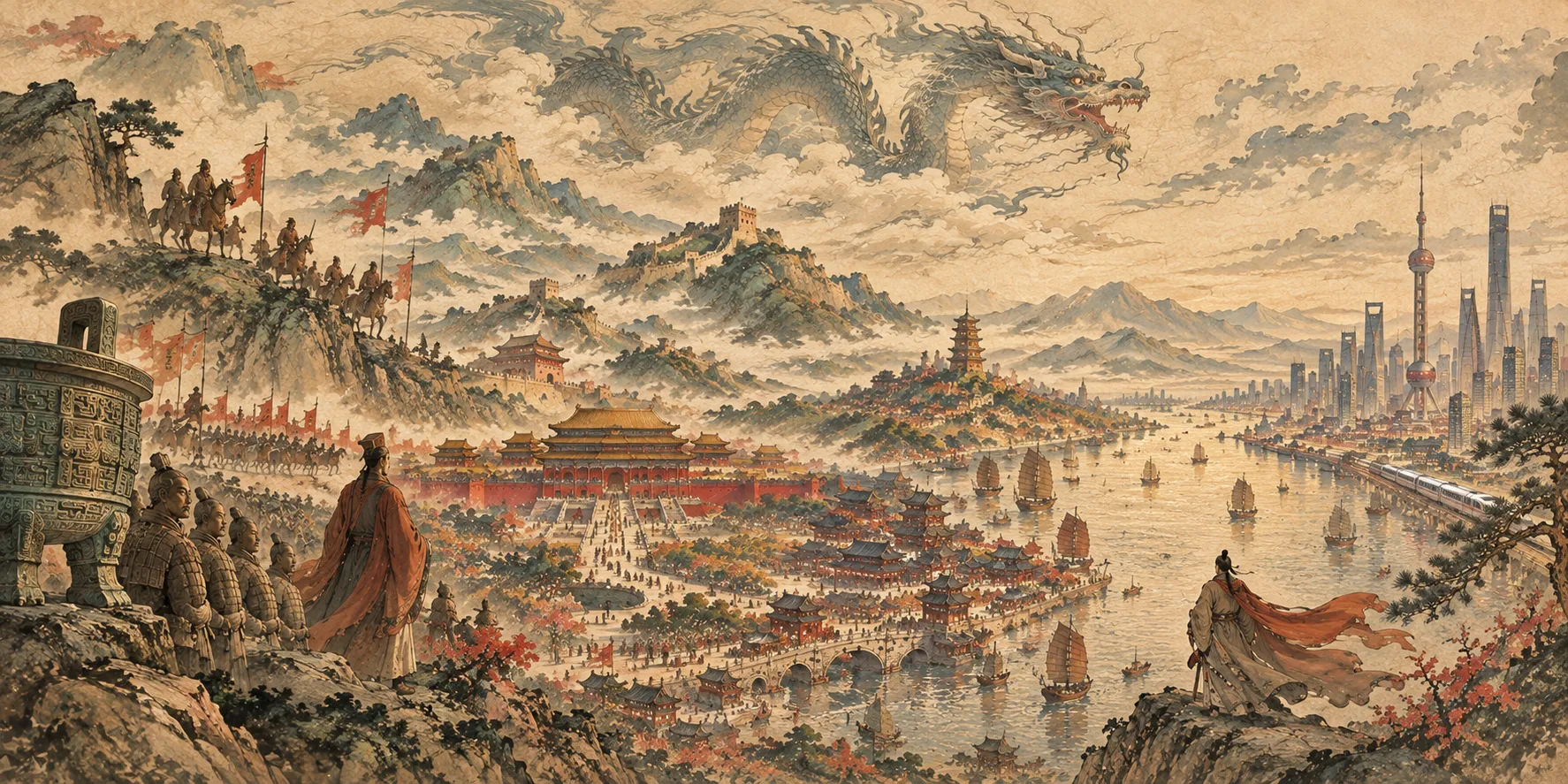
Bronze vessels and terracotta warriors, mounted armies, the Great Wall, the Forbidden City, a pagoda, sailing ships on a great river and the skyline of modern Shanghai, painted as one continuous scroll with a dragon in the sky

Chinese history at a glance

Chinese history begins with the Neolithic cultures of the Yellow River and Yangtze basins. After the Shang and Zhou, and the rivalries of the Spring and Autumn and Warring States periods, the First Emperor of Qin unified China for the first time in 221 BC.

Then came the Han, the Three Kingdoms, the Jin, the Northern and Southern Dynasties, the Sui, Tang, Five Dynasties, Song, Yuan, Ming and Qing — five thousand years of dynasties rising and falling — leading to the Republic of China in 1912 and the People’s Republic in 1949.

This timeline divides Chinese history by dynasty and walks through its key events, people and culture in chronological order. Tap any event to read its background and significance, along with the people, sites and treasures connected to it.

Timeline of Chinese history (24 eras)

Neolithic Cultures

c. 8000 BC – 2070 BC

In 8000 BC there was no country called “China” anywhere. Along the Yellow River and the Yangtze, people began to grow rice and fire painted pottery. The Yellow Emperor, Yao, Shun and Yu of myth, legend and archaeology intertwine in this age — the quiet opening of a five-thousand-year story.

Explore this era →
  1. c. 5000 BCCulture
    Rice Farming of the Hemudu Culture

    The Hemudu site near Yuyao, Zhejiang, in the lower Yangtze basin has yielded large quantities of carbonized rice husks, bone farming tools and the post holes of stilt houses, giving a picture of one of China’s oldest rice-farming cultures. Its raised buildings…

    Read more →
  2. c. 5000 BCCulture
    Rise of the Yangshao Culture

    A Neolithic culture that spread across Shaanxi, Henan and Shanxi in the middle Yellow River basin, known for its painted pottery with black and red designs on a red ground. At Banpo near Xi’an, its best-known site, a moated village, pit dwellings and a communa…

    Read more →
  3. c. 4000 BCCulture
    The Dawenkou Culture

    A Neolithic culture centered on Shandong, marked by refined painted pottery, thin black pottery and advancing jade-working techniques. Grave goods in its cemeteries range from rich to meager, taken as evidence that private wealth and social stratification were…

    Read more →
  4. c. 3000 BCCulture
    Rise of the Longshan Culture

    Named after its first discovery at Chengziya in Zhangqiu, Shandong, this culture is known for thin, lustrous black pottery shaped on the potter’s wheel. Settlements with rammed-earth walls have been found in many places, suggesting rising tension between group…

    Read more →
  5. c. 2700 BCWar & Conflict
    The Yellow Emperor vs. Chiyou (Legend)

    The best-known founding conflict in Chinese mythology tells how the Yellow Emperor defeated Chiyou, a chieftain of another people, at Zhuolu. The accounts were compiled in much later texts and cannot be confirmed as history, though some scholars see in them a …

    Read more →
  6. c. 2200 BCCulture
    The Abdication of Yao and Shun (Legend)

    Legend tells that Yao passed the throne to Shun, and Shun in turn to Yu — the ideal of shanrang, handing power to the virtuous rather than by strength or bloodline. Later Confucians praised this story again and again as the model of good government, and it bec…

    Read more →

Xia

c. 2070 BC – 1600 BC

When Yu tamed the floods of the Yellow River, the throne passed by blood for the first time. The age of legendary sage-kings yielding the throne to one another ended, and hereditary rule began — the Xia, the first dynasty in Chinese history. Whether it truly existed remains a mystery.

Explore this era →
  1. c. 2070 BCDynasty
    Yu Founds the Xia

    The Xia, said to be China’s oldest dynasty, arose from the trust Yu won by taming the great floods of the Yellow River. Yu is said to have received the throne from Shun, then passed it to his own son Qi, setting the precedent of hereditary succession in place …

    Read more →
  2. c. 2070 BCCulture
    Taming the Great Flood

    Learning from the failure of his father Gun, Yu is said to have abandoned damming in favor of cutting channels to lead the water to the sea, ending the floods of the Yellow River basin. He traveled ceaselessly for this work, and the tale that he passed his own…

    Read more →
  3. c. 2000 BCWar & Conflict
    Tai Kang Loses the Realm

    Tai Kang, Yu’s grandson, was so absorbed in hunting and pleasure that he neglected government, and power was seized by Yi (Hou Yi), chief of the powerful Youqiong tribe in the east. A legendary archer, Yi is said to have taken control while Tai Kang was away f…

    Read more →
  4. c. 1940 BCDynasty
    The Restoration of Shao Kang

    Shao Kang, a member of the Xia royal house after it lost power, is said to have lived in exile, wandering from place to place while rallying supporters, until he drove out the Youqiong and restored Xia rule. This revival, known as the “Restoration of Shao Kang…

    Read more →
  5. c. 1600 BCDynasty
    The Tyranny of King Jie

    Jie, said to be the last Xia king, doted on his favorite consort Moxi, indulged in “lakes of wine and forests of meat,” and ruled harshly with no regard for his people. Having lost the trust of nobles and commoners, he saw one faction after another defect to K…

    Read more →
  6. c. 1600 BCWar & Conflict
    Battle of Mingtiao and the Fall of Xia

    Backed by the nobles, King Tang of Shang defeated Jie’s army at Mingtiao (thought to be in today’s southern Shanxi), bringing the Xia to an end. Before rising up, Tang is said to have appointed Yi Yin as his chief minister and steadily built his strength. The …

    Read more →

Shang (Yin)

1600 BC – 1046 BC

Characters carved into tortoise shells and animal bones break three thousand years of silence. They are oracle-bone inscriptions, China’s oldest certain written records — memories of a bronze civilization devoted to divination and ritual. Yet even this glorious dynasty went up in flames and collapsed under the tyrant King Zhou.

Explore this era →
  1. c. 1600 BCDynasty
    King Tang Founds the Shang

    After defeating Jie of Xia at Mingtiao, King Tang founded a new dynasty, the Shang (also called Yin). Aided by his able minister Yi Yin, Tang put his government in order and won the confidence of the surrounding lords before moving to overthrow the Xia. Under …

    Read more →
  2. c. 1300 BCDynasty
    Pan Geng Moves the Capital

    Since its founding the Shang had moved its capital many times, owing to floods and other causes, but King Pan Geng — traditionally the 19th king — settled it at Yin (present-day Anyang, Henan), after which the dynasty enjoyed long stability. The aristocracy is…

    Read more →
  3. c. 1250 BCCulture
    Oracle-Bone Script

    When the king divined on important matters of state, tortoise shells or ox shoulder blades were heated until they cracked, the omen was read from the cracks, and the question and result were carved into the bone — this is oracle-bone script. The oldest survivi…

    Read more →
  4. c. 1200 BCForeign Relations
    The Reign of Wu Ding and Fu Hao

    Under Wu Ding, when the Shang was at its strongest, oracle bones record that his consort Fu Hao personally led armies against neighboring peoples, a time when Shang power expanded greatly. The inscriptions also suggest she presided over sacrifices as a prieste…

    Read more →
  5. c. 1075 BCDynasty
    The Tyranny of King Zhou

    Zhou, said to be the last Shang king, doted on his consort Daji, indulged in “lakes of wine and forests of meat” and put remonstrating ministers to cruel punishments — long told as the archetypal tyrant. Yet many of these tales come from later texts, especiall…

    Read more →
  6. 1046 BCWar & Conflict
    Battle of Muye

    Amid the nobles’ discontent with King Zhou’s misrule and heavy taxes, King Wu of Zhou, who had been building strength in the west, led an allied army against the Shang and met it in a decisive battle at Muye near the Shang capital. The Shang army collapsed, an…

    Read more →

Western Zhou

1046 BC – 771 BC

Having overthrown the Shang, King Wu raised a new principle of rule: the Mandate of Heaven — a king who loses his virtue is abandoned by Heaven. The Duke of Zhou laid down the institutions of ritual and music, building the order Confucius would later hold up as ideal. But invading peoples from the west brought the capital down.

Explore this era →
  1. 1046 BCDynasty
    Founding of the Zhou

    Having destroyed the Shang at Muye, King Wu set his capital at Haojing in the Wei River basin (near present-day Xi’an) and founded the Zhou dynasty. The Zhou explained their legitimacy through the Mandate of Heaven: Heaven had entrusted them with rule in place…

    Read more →
  2. 1043 BCCulture
    Establishing the Fengjian (Enfeoffment) System

    The Zhou royal house enfeoffed kinsmen, loyal followers and the chiefs of submitted peoples as lords across the land, entrusting them with the rule of their fiefs. Lords owed the king military service and tribute but governed their own domains, and order was m…

    Read more →
  3. c. 1042 BCCulture
    The Duke of Zhou’s Regency and the Rites

    The Duke of Zhou, King Wu’s brother, governed as regent for the young King Cheng and stabilized the dynasty by crushing a rebellion of Shang loyalists (the Rebellion of the Three Guards). He is also said to have systematized li — codes of conduct suited to ran…

    Read more →
  4. c. 1000 BCDynasty
    The Peace of Cheng and Kang

    The reigns of King Cheng and his successor King Kang are said to have been so peaceful that punishments went unused for over forty years, long remembered as the ideal golden age of the Zhou. The inscription on the He zun, a bronze cast in this period, records …

    Read more →
  5. 841 BCWar & Conflict
    The Uprising of 841 BC and the Gonghe Regency

    Against King Li’s oppression and suppression of speech, the “guoren” — residents of the capital — rose up, and King Li fled to Zhi in Shanxi. With no king present, leading ministers including the Dukes of Zhou and Shao governed jointly in an unusual arrangemen…

    Read more →
  6. 771 BCWar & Conflict
    Invasion of the Quanrong and Death of King You

    King You, infatuated with his consort Bao Si, is said to have lit the beacon fires again and again to make her laugh, summoning the lords for nothing — so when the Quanrong of the west truly invaded, no one came to his aid. The tale of “toying with the lords b…

    Read more →

Spring and Autumn

770 BC – 403 BC

Having fled east, the Zhou court no longer had the power to command the realm. Under a figurehead Son of Heaven, the lords vied for hegemony — Duke Huan of Qi, Duke Wen of Jin. It was in this age of division and chaos that Confucius was born and the Hundred Schools of Thought first took root.

Explore this era →
  1. 770 BCDynasty
    King Ping Moves the Capital East

    After the fall of the Western Zhou, King Ping, with the lords’ support, moved the capital from Haojing east to Luoyi (present-day Luoyang). The Zhou after this move is called the Eastern Zhou, and its first half the Spring and Autumn period. The royal domain s…

    Read more →
  2. 679 BCDynasty
    Duke Huan of Qi Becomes Hegemon

    Duke Huan of the great eastern state of Qi generously appointed Guan Zhong — a retainer of his rival who had once tried to kill him — as chief minister, and Guan Zhong’s brilliant administrative and economic reforms greatly strengthened the state. Under the ba…

    Read more →
  3. 632 BCWar & Conflict
    Duke Wen of Jin and the Battle of Chengpu

    Duke Wen of Jin (Chong’er) is known for his dramatic life: fleeing political strife at home, he spent 19 years in exile among other states before finally returning to take the throne. As duke he contested the Central Plain with the great southern state of Chu …

    Read more →
  4. 551 BCCulture
    Birth of Confucius

    Born in Zou in the state of Lu (near present-day Qufu, Shandong), Confucius mastered ritual from a young age and later traveled among the states with many disciples, teaching an ideal politics of benevolence (ren) and ritual (li). His willingness to accept stu…

    Read more →
  5. 494 BCWar & Conflict
    Wu vs. Yue: “Sleeping on Brushwood, Tasting Gall”

    Wu and Yue, rivals for supremacy in the lower Yangtze, waged bitter war for decades. Badly defeated by Wu at Kuaiji, King Goujian of Yue accepted a humiliating peace and became a vassal, then tasted bitter gall to remind himself of his grudge as he rebuilt his…

    Read more →
  6. 453 BCWar & Conflict
    The Partition of Jin

    In Jin, long the leading hegemon of the Central Plain, the ducal house weakened while the great ministerial families of Han, Wei and Zhao took real power. In 453 BC the three destroyed their rival the Zhi family and divided its lands, effectively splitting Jin…

    Read more →

Warring States

403 BC – 221 BC

When the great state of Jin split in three, order and propriety were gone. What remained was naked survival of the fittest, seven powerful states killing one another to survive — two centuries worthy of the name “Warring States.” At its end, the realm converged on a single man.

Explore this era →
  1. 403 BCDynasty
    Formal Recognition of the Partition of Jin

    King Weilie of Zhou formally recognized the Han, Wei and Zhao families, who already ruled Jin’s lands between them, as lords of independent states. Jin thus vanished in name as well as fact, and the three new states joined the leading powers of the Warring Sta…

    Read more →
  2. 356 BCCulture
    Shang Yang’s Reforms in Qin

    Employed in Qin, a backward state in the west, the Legalist statesman Shang Yang carried out sweeping reforms grounded in strict rule of law with the full backing of Duke Xiao: ranks and land awarded for military merit regardless of birth, collective responsib…

    Read more →
  3. 4th century BCCulture
    Height of the Hundred Schools of Thought

    As Zhou authority faded and the states fought to survive, a wide range of thinkers traveled from court to court, urging their ideas on how to strengthen the state and govern well. The Confucian Mencius argued for kingly government based on the goodness of huma…

    Read more →
  4. 333 BCForeign Relations
    Vertical and Horizontal Alliances

    In response to Qin’s growing might, a dizzying diplomatic battle unfolded between the “vertical alliance” (hezong), in which the six eastern states joined to resist Qin, and the “horizontal alliance” (lianheng), in which Qin allied with individual states to di…

    Read more →
  5. 260 BCWar & Conflict
    Battle of Changping

    In this clash between the two great powers Qin and Zhao, Zhao’s general Lian Po had settled into a war of attrition, but he was replaced by the inexperienced Zhao Kuo, and the famed Qin general Bai Qi seized the chance to encircle and annihilate the Zhao army.…

    Read more →
  6. 221 BCDynasty
    End of the Warring States

    Having destroyed Han, Zhao, Wei, Chu and Yan one after another, King Zheng of Qin (later the First Emperor) subdued Qi, the last independent state in the east, and unified the whole land. This ended an age of division and conflict that had lasted about 180 yea…

    Read more →

Qin

221 BC – 206 BC

In 221 BC, after five hundred years of war, the realm at last fell into the hands of one man: King Zheng of Qin, a state risen from the western frontier — the future First Emperor. He standardized weights and measures and the script, built the Great Wall, and was the first ever to call himself “emperor.” Yet the empire built at the summit of his power collapsed in just fifteen years — the most dramatic unification and fall in Chinese history.

Explore this era →
  1. 221 BCDynasty
    The First Emperor Unifies China

    Destroying Qi, the last of the Seven Warring States to resist, King Zheng of Qin unified all of China for the first time in history. He then created the title huangdi, “emperor,” to proclaim an authority surpassing even the legendary Three Sovereigns and Five …

    Read more →
  2. 221 BCCulture
    The Commandery–County System

    Abolishing the kinship-based feudal system that had existed since the Zhou, Qin divided the country into 36 commanderies (later more than 40), each subdivided into counties — a two-tier system of local government. Said to have been proposed by the chancellor L…

    Read more →
  3. 214 BCCulture
    Building the Great Wall

    After ordering General Meng Tian to drive the Xiongnu north, the emperor had the separate walls built by Yan, Zhao, Qin and others during the Warring States linked and repaired, creating a vast defensive line from Lintao (in present-day Gansu) in the west to L…

    Read more →
  4. 213 BCCulture
    Burning of Books and Burying of Scholars

    On the advice of the chancellor Li Si, histories of the other states, Confucian classics and other works were burned — sparing only practical books on medicine, divination and agriculture and Qin’s own records — in an attempt to control thought and speech. The…

    Read more →
  5. 209 BCWar & Conflict
    The Chen Sheng and Wu Guang Uprising

    A band of peasants conscripted for frontier duty, led by Chen Sheng and Wu Guang, was delayed by heavy rain and faced execution under the law for arriving late — so they rose up with the cry, “Are kings, lords, generals and ministers born to their rank?” The r…

    Read more →
  6. 206 BCWar & Conflict
    Fall of Qin and the Feast at Hongmen

    Of the two leaders of the anti-Qin forces, Xiang Yu and Liu Bang, it was Liu Bang who first entered the Guanzhong region and took the Qin capital Xianyang. Furious, the later-arriving Xiang Yu invited Liu Bang to a banquet at Hongmen. There Xiang Yu’s adviser …

    Read more →

Western Han

206 BC – 8 AD

When the First Emperor’s empire fell, the man who won the realm was no aristocrat but Liu Bang, a man of peasant birth. Under Emperor Wu the empire stretched to the Western Regions, the Silk Road opened and Confucianism became the ideology of the state — and so the name “Han,” borne for four centuries, became a synonym for China itself.

Explore this era →
  1. 202 BCDynasty
    Liu Bang Founds the Han

    Victorious in the years-long Chu–Han Contention with Xiang Yu after Qin’s fall, Liu Bang cornered Xiang Yu at Gaixia, driving him to suicide, and in 202 BC took the throne as emperor, founding the Han dynasty. His rise from peasant origins — an unusually humbl…

    Read more →
  2. 180 BCDynasty
    End of Empress Lü’s Domination

    Lü Zhi (Empress Lü), Liu Bang’s empress, took power after his death through her young son Emperor Hui, and after Hui’s death continued to place members of her own Lü clan in high posts, tightening her grip. The story of her brutal murder of her rival Lady Qi, …

    Read more →
  3. 154 BCWar & Conflict
    Rebellion of the Seven States

    In reaction to the policy of reducing the vassal kings’ domains pushed by Emperor Jing’s minister Chao Cuo, seven kingdoms led by Liu Pi, King of Wu, and including Chu and Zhao rose in rebellion. Chao Cuo was executed to remove the rebels’ pretext, but the rev…

    Read more →
  4. 141 BCDynasty
    Accession of Emperor Wu

    Taking the throne at 16, Emperor Wu reigned for 54 years and raised the Western Han to the height of its power. Abroad, his generals Wei Qing and Huo Qubing drove the long-threatening Xiongnu far to the north, and he conquered Nanyue and Wiman Joseon on the Ko…

    Read more →
  5. 138 BCForeign Relations
    Zhang Qian Travels to the Western Regions

    Sent to seek the Yuezhi as allies for a pincer attack on the Xiongnu, Zhang Qian met hardship after hardship — captured by the Xiongnu on the way, he was held for more than ten years. When he finally escaped and reached the Yuezhi, they had lost the will to fi…

    Read more →
  6. 134 BCCulture
    Confucianism Becomes the State Orthodoxy

    When the Confucian scholar Dong Zhongshu urged Emperor Wu, in his “Three Responses on Heaven and Man,” to reject all other schools and make Confucianism alone the orthodox learning of the state, Confucianism began to establish itself as the de facto state ideo…

    Read more →

Xin (Wang Mang)

8 AD – 23 AD

Wang Mang, who rose to power as a relative of the Han empresses, at last usurped the throne and founded his own Xin dynasty. His idealistic, back-to-antiquity reforms all foundered on reality, and in just fifteen years the realm fell back into chaos.

Explore this era →
  1. AD 8Dynasty
    Wang Mang Takes the Throne

    Wang Mang, nephew of Wang Zhengjun, empress of Emperor Yuan of the Western Han, built up power at court over many years as an imperial in-law, and after Emperor Ping’s death took control as regent for the infant Ruzi Ying. After arranging for auspicious omens …

    Read more →
  2. AD 9Culture
    Back-to-Antiquity Land and Currency Reforms

    Seeking to realize the ideals of the Rites of Zhou, Wang Mang declared all land “royal fields,” nationalizing it and banning private sales, restricted the sale of slaves, and pushed through one radical social and economic reform after another. He abolished the…

    Read more →
  3. AD 17War & Conflict
    The Lülin Rebellion

    Based on Mount Lülin in Hubei, Wang Kuang, Wang Feng and others gathered famine-stricken peasants and rose up at about the same time as the Red Eyebrows, adding to the chaos at the end of the Xin. At first only a small band holed up in the mountains, it scatte…

    Read more →
  4. AD 18War & Conflict
    The Red Eyebrows Rebellion

    In Shandong, where economic chaos from repeated recoinages combined with famine caused by Yellow River floods, peasants led by Fan Chong rose in rebellion. They are said to have been named for dyeing their eyebrows red to tell friend from foe. At first a simpl…

    Read more →
  5. AD 23War & Conflict
    Battle of Kunyang

    Liu Xiu, rising in prominence under the Gengshi regime, defeated a huge army raised by Wang Mang — said to number in the hundreds of thousands — with fewer than ten thousand men. To relieve his comrades besieged in Kunyang, Liu Xiu personally led a desperate c…

    Read more →
  6. AD 23War & Conflict
    Death of Wang Mang and Fall of the Xin

    After the disaster at Kunyang the Xin regime’s authority collapsed completely; when the Gengshi Emperor’s forces closed on Chang’an the capital fell, and Wang Mang was cornered in the palace and killed. His body is said to have been hacked to pieces by an angr…

    Read more →

Eastern Han

25 AD – 220 AD

Liu Xiu, of the Liu bloodline, restored the Han and made Luoyang his capital. Paper was invented and rule over the Western Regions resumed — civilization flowered again, but power struggles between eunuchs and imperial in-laws quietly ate away at the dynasty’s foundations. With the beacon of the Yellow Turban Rebellion, the age plunged into chaos and the rivalry of heroes.

Explore this era →
  1. AD 25Dynasty
    Emperor Guangwu Restores the Han

    Rising to prominence in the Lülin army amid the chaos at the end of the Xin, Liu Xiu united rival forces after victories such as Kunyang and in AD 25 took the throne, proclaiming the restoration of the Han. Though said to be a ninth-generation descendant of Li…

    Read more →
  2. AD 73Foreign Relations
    Ban Chao in the Western Regions

    Ban Chao, younger brother of Ban Gu, compiler of the History of the Han (Hanshu), was sent to the Western Regions with an embassy against the Xiongnu and stayed active there for nearly thirty years. As the proverb attributed to him — “How can you catch a tiger…

    Read more →
  3. AD 105Culture
    Cai Lun Improves Papermaking

    Paper-like materials existed before, but they were expensive or poorly suited to writing. According to the Book of the Later Han, Cai Lun, a eunuch at court, combined cheap, everyday materials — tree bark, hemp waste, rags and fishing nets — and through repeat…

    Read more →
  4. AD 166Culture
    The Proscription of Factions

    From the mid-Eastern Han, a succession of child emperors entrenched a pattern in which imperial in-laws and eunuchs took turns holding power, and upright officials and students of the Imperial Academy began to speak out. Calling themselves the “pure stream” an…

    Read more →
  5. AD 184War & Conflict
    The Yellow Turban Rebellion

    Amid eunuch misrule and unrest caused by repeated natural disasters, followers of the Way of Great Peace (Taiping Dao), a religious movement founded by Zhang Jue, launched a massive peasant rebellion. Named the Yellow Turbans for the yellow cloths they wore on…

    Read more →

Three Kingdoms

220 – 280

Cao Cao, Liu Bei, Sun Quan — three heroes split the realm in three in the most retold age of turmoil in Chinese history. The flames of Red Cliffs, Zhuge Liang’s dream fading at Wuzhang Plains. Yet in the end, none of the three had the last laugh.

Explore this era →
  1. 208War & Conflict
    Battle of Red Cliffs

    Having nearly unified North China, Cao Cao pushed south, took Jing Province and pressed on across the Yangtze to unify the realm — but the alarmed Sun Quan allied with Liu Bei, who had been driven from Jing Province, to resist him. Cao Cao’s army was vastly la…

    Read more →
  2. 220Dynasty
    Founding of Wei (Cao Pi)

    Cao Cao never called himself emperor, ruling as Chancellor and King of Wei under the Han, but soon after his death his heir Cao Pi pressed Emperor Xian to abdicate and in 220 took the throne, founding Wei. With its capital at Luoyang, Wei built on the unificat…

    Read more →
  3. 221Dynasty
    Founding of Shu Han (Liu Bei)

    Liu Bei, who claimed descent from Emperor Jing of the Western Han, fought across the land from his youth without a power base of his own, until he took Zhuge Liang as his strategist and secured Jing and Yi provinces. In 221, on news of Cao Pi’s founding of Wei…

    Read more →
  4. 222Dynasty
    Founding of Wu (Sun Quan)

    Sun Quan inherited at a young age the power base his father Sun Jian and brother Sun Ce had built in Jiangdong, and with able ministers such as Zhou Yu, Lu Su and Lü Meng steadily consolidated his rule over the south. His diplomatic skill shows in how he prese…

    Read more →
  5. 234War & Conflict
    Battle of Wuzhang Plains

    After Liu Bei’s death, Zhuge Liang, entrusted with full authority over Shu Han as chancellor, raised the banner of “restoring the Han house” against far stronger Wei and, beginning with his “Memorial on Dispatching the Troops” in 227, launched repeated norther…

    Read more →
  6. 263War & Conflict
    Fall of Shu Han

    After Zhuge Liang’s death, Jiang Wei carried on his northern expeditions against Wei, but without major success they only drained the state, and Shu politics grew disordered under the domination of the eunuch Huang Hao and others. In 263 Sima Zhao, then in con…

    Read more →

Western Jin

265 – 316

The Sima clan, masters of Wei, at last unified the Three Kingdoms. But the brief peace did not last. The War of the Eight Princes, sparked by an empress’s bid for power, grew into kin devouring kin, and the unified dynasty began to crumble within just fifty years.

Explore this era →
  1. 265Dynasty
    Sima Yan Founds the Western Jin

    In Wei, real power passed step by step to the Sima clan over three generations — Sima Yi, Sima Shi and Sima Zhao — and the conquest of Shu Han in 263 made Sima Zhao’s authority decisive. His son Sima Yan received the throne from Emperor Yuan of Wei by abdicati…

    Read more →
  2. 280Dynasty
    The Western Jin Reunifies China

    In 280 the Western Jin, sending a fleet under Wang Jun down the Yangtze, destroyed Wu, the last holdout, and at last reunified a China divided for nearly a century since the Yellow Turban Rebellion. With the fall of Wu, the Three Kingdoms period — when Wei, Sh…

    Read more →
  3. 291War & Conflict
    Outbreak of the War of the Eight Princes

    Emperor Hui, who succeeded Emperor Wu, is said to have been feeble-minded, and when his empress Jia Nanfeng tried to seize power, the imperial princes enfeoffed across the land one after another intervened in the struggle for the throne. Named for the eight pr…

    Read more →
  4. 304War & Conflict
    The Invasions of the Five Barbarians Begin

    As the War of the Eight Princes drained the Western Jin, Liu Yuan, descended from the chanyu of the Southern Xiongnu, built up his strength while supporting one of the princes, then in 304 declared independence, styled himself emperor and named his state Han (…

    Read more →
  5. 311War & Conflict
    The Disaster of Yongjia

    Liu Cong, Liu Yuan’s successor, ordered generals such as Shi Le to step up the attack on the Western Jin and in 311 besieged and took the capital Luoyang. The city was looted and massacred, and Emperor Huai of Jin was captured, taken to the Han (Former Zhao) c…

    Read more →
  6. 316War & Conflict
    Fall of the Western Jin

    After Emperor Huai’s capture, imperial kinsmen and ministers who had escaped Luoyang installed Emperor Min at Chang’an, barely keeping the Western Jin alive. But Chang’an’s defenses were weak and food was short, and when the Han (Former Zhao) army attacked aga…

    Read more →

Sixteen Kingdoms & Eastern Jin

317 – 420

Mounted peoples of the north poured into the Central Plain one after another, and in North China more than ten dynasties rose and vanished — the great upheaval of the “Sixteen Kingdoms of the Five Barbarians.” The Han Chinese court fled south of the Yangtze and survived as the Eastern Jin, but the age of north–south division would last more than two centuries from here.

Explore this era →
  1. 317Dynasty
    Founding of the Eastern Jin

    Escaping the fall of Luoyang to the Xiongnu-led Han (Former Zhao) in the Disaster of Yongjia, the Western Jin prince Sima Rui crossed south and founded the Eastern Jin with its capital at Jiankang (present-day Nanjing). He secured his regime with the backing o…

    Read more →
  2. 4th centuryWar & Conflict
    Rise and Fall of the Sixteen Kingdoms

    Peoples of the north and west known as the “Five Barbarians” — Xiongnu, Xianbei, Jie, Di and Qiang — flowed into the Central Plain and founded many regimes across North China, including Former Zhao, Later Zhao, Former Yan, Later Qin and Xia, which rose and wer…

    Read more →
  3. 369War & Conflict
    Huan Wen’s Northern Expeditions

    Huan Wen, the strongman of the Eastern Jin, used his military power as Inspector of Jing Province to launch three northern expeditions, at one point even retaking Luoyang and winning great military renown. But on his third expedition in 369, against Former Yan…

    Read more →
  4. 376Dynasty
    Fu Jian Unifies the North under Former Qin

    Fu Jian of the Di people, on becoming the third ruler of Former Qin, appointed the able Han Chinese minister Wang Meng, carried out administrative reforms and built up his army, conquering Former Yan, Former Liang, Dai (of the Tuoba) and others until he had un…

    Read more →
  5. 383War & Conflict
    Battle of Fei River

    Ignoring Wang Meng’s dying advice, Fu Jian marched south with a host said to number a million to conquer the Eastern Jin, but at the Fei River (in present-day Anhui) he was routed by a much smaller force led by the Jin chancellor Xie An and general Xie Xuan. T…

    Read more →
  6. 420Dynasty
    Fall of the Eastern Jin

    Liu Yu, from a humble family but brilliant in war, rose through achievements such as suppressing the rebellion of Sun En and Lu Xun and a successful northern expedition against Later Qin, until he held real power in the Eastern Jin. In 420 he finally received …

    Read more →

Northern & Southern Dynasties

420 – 589

Southern Dynasties in Jiangnan, Northern Dynasties in the north — a China split in two spent nearly two centuries as dynasties rose and fell on each side. The sinicization policies of Emperor Xiaowen of Northern Wei, the aristocratic culture and Buddhist art that flowered in the south: behind the division, the ground for the next great unification was quietly being prepared.

Explore this era →
  1. 420Dynasty
    Founding of the Liu Song

    When the general Liu Yu took the throne by abdication from Emperor Gong of the Eastern Jin and named his dynasty Song (Liu Song), the age of the Southern Dynasties began. Liu Yu promoted men of humble families and placed some limits on aristocratic privilege, …

    Read more →
  2. 439Dynasty
    Northern Wei Unifies the North

    The Northern Wei, founded by the Tuoba Xianbei, conquered the remaining northern regimes — Xia, Northern Yan, Northern Liang and others — under Emperor Taiwu (Tuoba Tao), and in 439 ended the division of North China that had lasted since the Sixteen Kingdoms. …

    Read more →
  3. 494Culture
    Northern Wei Sinicization

    Emperor Xiaowen of Northern Wei moved the capital from Pingcheng to Luoyang in the heart of the Central Plain and pushed rapid sinicization, requiring the Xianbei to adopt Chinese dress and language and changing the imperial surname from Tuoba to Yuan. He also…

    Read more →
  4. 502Dynasty
    Xiao Yan Founds the Liang

    Xiao Yan, a member of the Southern Qi clan, took advantage of strife at the end of Southern Qi to raise an army and in 502 founded the Liang by abdication, later known as Emperor Wu. His 48-year reign was one of the longest of the Southern Dynasties; he genero…

    Read more →
  5. 534War & Conflict
    The Split of Northern Wei

    Weakened by repeated revolts beginning with the Six Garrisons Rebellion, the Northern Wei saw its strongmen Gao Huan and Yuwen Tai each install a different prince, and in 534 it split into Eastern Wei (capital Ye, controlled by Gao Huan) and Western Wei (capit…

    Read more →
  6. 589Dynasty
    Sui Reunifies North and South

    Chen, the last of the Southern Dynasties, had been badly weakened by its emperor Chen Shubao (the Last Ruler of Chen), who neglected government for a life of pleasure; the voluptuous song “Jade Tree Blossoms in the Rear Court,” said to be his own composition, …

    Read more →

Sui

581 – 618

Emperor Wen at last bound the divided north and south into one. The Sui cut the Grand Canal and created a new system of selecting officials, the imperial examinations. But the endless campaigns and huge building projects of its second emperor, Yang, exhausted the people, and within forty years of unification the dynasty went up in flames.

Explore this era →
  1. 581Dynasty
    Yang Jian Founds the Sui

    Yang Jian, a powerful in-law of the Northern Zhou imperial family, founded the Sui by abdication from the child Emperor Jing and took the throne as Emperor Wen. He too came from the Guanlong group organized by Yuwen Tai, embodying the rise of a unifying dynast…

    Read more →
  2. 589Dynasty
    Conquest of Chen and Reunification

    Emperor Wen of Sui ordered his generals He Ruobi and Han Qinhu to cross the Yangtze against Chen, last of the Southern Dynasties, weakened by its ruler’s life of pleasure. The emperor Chen Shubao (the Last Ruler of Chen) was captured in Jiankang with almost no…

    Read more →
  3. 605Culture
    Creation of the Imperial Examinations

    Under Emperor Yang of Sui, the jinshi examination — testing learning and talent rather than family background to select officials — was established, regarded as the effective beginning of what was later called the keju, the imperial examination system (similar…

    Read more →
  4. 605Culture
    Building the Grand Canal

    To create a waterway network linking north and south, Emperor Yang pressed ahead with the Grand Canal, connecting and enlarging existing rivers and canals. Sections such as the Yongji, Tongji, Hangou and Jiangnan canals were dug one after another, completing a…

    Read more →
  5. 612Foreign Relations
    Failed Campaigns against Goguryeo

    To subjugate Goguryeo, Emperor Yang launched three massive campaigns in 612, 613 and 614, mobilizing for the first an unprecedented army said to exceed one million men. But the Goguryeo general Eulji Mundeok skillfully lured the Sui forces into a catastrophic …

    Read more →
  6. 618War & Conflict
    Assassination of Emperor Yang and Fall of Sui

    In his last years, faced with failed campaigns and revolts everywhere, Emperor Yang left Luoyang and Chang’an for Jiangdu (present-day Yangzhou), where he is said to have sunk into a life of pleasure as if turning away from reality. Discontent grew among the p…

    Read more →

Tang

618 – 907

Learning from the Sui’s failure, Li Yuan and his son Li Shimin built a new empire. Chang’an became one of the largest cosmopolitan cities in the world, with goods and ideas flowing along the Silk Road — the most international golden age in Chinese history. But after the An Lushan Rebellion, the glorious empire began a slow decline.

Explore this era →
  1. 618Dynasty
    Li Yuan Founds the Tang

    Li Yuan, regent of Taiyuan, took advantage of the chaos at the end of the Sui to raise an army in 617 and soon took Chang’an, at first installing Emperor Yang’s grandson as emperor to keep up the appearance of Sui rule. But in 618, on news that Emperor Yang ha…

    Read more →
  2. 626War & Conflict
    Xuanwu Gate Incident and Emperor Taizong

    Crown Prince Li Jiancheng and his brother Li Yuanji, fearing their brother Li Shimin, whose many victories had won him great prestige, are said to have plotted his assassination. Learning of it, Li Shimin in 626 laid an ambush at Xuanwu Gate, the north gate of…

    Read more →
  3. 630Foreign Relations
    Conquest of the Eastern Turks

    In the early Tang the Eastern Turks to the north were militarily powerful, and soon after his accession Taizong was confronted near Chang’an itself and forced into a humiliating peace (the Pact of the Wei River). Using this humiliation as a spur to build up th…

    Read more →
  4. 630sCulture
    Xuanzang’s Journey to India and the Flowering of Buddhism

    Although leaving the country was then forbidden, Xuanzang, seeking more accurate Buddhist scriptures, secretly crossed the border and made a grueling journey across the wastes of the Western Regions and Central Asia to India. He studied for years at the great …

    Read more →
  5. 690Dynasty
    Wu Zetian Founds the Zhou and Becomes Emperor

    Wu Zetian, who entered Taizong’s harem and later became Emperor Gaozong’s empress, ruled from behind the screen after Gaozong’s death, deposed her own sons Zhongzong and Ruizong in turn, and in 690 renamed the dynasty Zhou and took the throne herself. The only…

    Read more →
  6. 755War & Conflict
    The An Lushan Rebellion

    In his later years Emperor Xuanzong, absorbed in his love for his consort Yang Guifei, neglected government, and a rivalry deepened between her kinsman Yang Guozhong and An Lushan, who held enormous military power as military governor of Pinglu, Fanyang and He…

    Read more →
  7. 907War & Conflict
    Zhu Quanzhong Usurps the Tang

    Zhu Quanzhong (Zhu Wen), who had once joined Huang Chao’s rebels, later went over to the Tang and helped suppress the revolt, in the process becoming the most powerful military governor of all. In 903 he wiped out the eunuchs, in 904 forced the move of the cap…

    Read more →

Five Dynasties & Ten Kingdoms

907 – 960

With the fall of the Tang, five short-lived dynasties rose and fell in dizzying succession on the Central Plain while ten kingdoms held the regions. This age of chaos, when dynasties changed again and again in barely half a century, finally ended with the appearance of the next unifier, Zhao Kuangyin.

Explore this era →
  1. 907Dynasty
    Founding of Later Liang

    Zhu Quanzhong (later Emperor Taizu), who had destroyed the Tang, founded the Later Liang with its capital at Kaifeng (Bianzhou), but his power base was far from secure. A succession struggle soon broke out — his son Zhu Yougui murdered him and seized the thron…

    Read more →
  2. 923Dynasty
    Founding of Later Tang

    Li Cunxu, son of Li Keyong, Prince of Jin, expanded his power carrying his father’s dying wish — the vow to destroy his enemies entrusted to three arrows — and in 923 finally destroyed the Later Liang, taking the throne himself (as Emperor Zhuangzong) and nami…

    Read more →
  3. 936Foreign Relations
    Cession of the Sixteen Prefectures

    Shi Jingtang, Later Tang military governor of Hedong, rebelled when the court grew suspicious of him and, lacking the strength to win alone, sought military aid from Yelü Deguang of the Khitan (Liao). In return he ceded the Sixteen Prefectures of Yan and Yun (…

    Read more →
  4. 947Dynasty
    Founding of Later Han

    When the Khitan (Liao) marched south, destroyed the Later Jin and briefly occupied Kaifeng, their harsh rule and plundering provoked mounting resistance from the people and local powers of the Central Plain, and the Khitan army soon had to withdraw north. Seiz…

    Read more →
  5. 951Dynasty
    Guo Wei Founds the Later Zhou

    Guo Wei, a senior minister of the Later Han, rose in arms after the young Emperor Yin suspected him of treason and had his family killed; when the emperor was killed by mutinous soldiers in the midst of the revolt, the generals acclaimed Guo Wei, and he took t…

    Read more →
  6. 959Dynasty
    Death of Emperor Shizong (Chai Rong)

    Emperor Shizong (Chai Rong) of Later Zhou is remembered as an able ruler who vigorously pursued unification, taking the strategic Huainan region from Southern Tang in the south and campaigning against the Khitan (Liao) in the north to recover Yingzhou, Mozhou …

    Read more →
  7. 960War & Conflict
    Zhao Kuangyin’s Coup

    Under the young Later Zhou emperor Gong, General Zhao Kuangyin marched out on reports of an invasion by the Khitan and Northern Han; at Chenqiao Station near Kaifeng his officers and men are said to have acclaimed him, draping him in a yellow robe — the empero…

    Read more →

Northern Song

960 – 1127

Reflecting on the rule of the sword, Zhao Kuangyin founded a new dynasty on the principle of civil government. Examination-recruited officials ran the state, and the economy and culture reached full ripeness — yet the Song, pressed constantly by non-Han states in the north, was militarily on the back foot throughout. And with the Jurchen Jin marching south, the capital fell.

Explore this era →
  1. 960Dynasty
    Zhao Kuangyin Founds the Song

    Taking the throne after the Chenqiao Mutiny, Zhao Kuangyin (Emperor Taizu) received the abdication of the Later Zhou, named his dynasty Song and made Kaifeng his capital. At his accession, regimes descended from the Ten Kingdoms — Jingnan, Later Shu, Southern …

    Read more →
  2. 961Culture
    “Relieving Military Power over a Cup of Wine”

    In 961, the year after his accession, Taizu invited Shi Shouxin and other powerful palace-army generals who had helped found the dynasty to a banquet and, alluding to how he himself had come to the throne (the yellow robe), is said to have skillfully explained…

    Read more →
  3. 986War & Conflict
    The Yongxi Northern Campaign and the Death of Yang Ye

    Emperor Taizong of Song, determined to recover the Sixteen Prefectures, saw his chance in 986 (the third year of Yongxi), seven years after his crushing defeat at the Gaoliang River, when the child emperor Shengzong took the Liao throne, and sent great armies …

    Read more →
  4. 1004Foreign Relations
    The Treaty of Chanyuan

    When the Liao emperor Shengzong and his mother Empress Dowager Xiao personally led a great army south to the river opposite Chanzhou (present-day Puyang, Henan), close to the Song capital Kaifeng, panic spread at the Song court, with some even urging that the …

    Read more →
  5. 1069Culture
    Wang Anshi’s New Policies

    In the mid-Northern Song, as the state struggled with worsening finances, the “three redundancies” of surplus officials, soldiers and expenses, and the heavy burden of annual gifts and defense against Liao and Western Xia, Wang Anshi, appointed by Emperor Shen…

    Read more →
  6. 1115Foreign Relations
    Founding of the Jin

    Wanyan Aguda, leader of the Jurchen under Liao rule, united the Jurchen tribes on a wave of discontent with Liao oppression and, after defeating a Liao army at Ningjiang in 1114, rapidly expanded his power. In 1115 he proclaimed himself emperor, named his dyna…

    Read more →
  7. 1127War & Conflict
    The Jingkang Incident and Fall of the Northern Song

    Having destroyed the Liao, the Jin, riding its momentum, broke its pact with the Northern Song and marched south. Kaifeng was besieged as early as 1126, but the Song persuaded the Jin to lift the siege by agreeing to a huge indemnity and the cession of territo…

    Read more →

Southern Song

1127 – 1279

Driven from their capital, the Song imperial family built a new capital, Lin’an, in the south and survived. Despite the valiant fight of loyal generals like Yue Fei, the Song was forced to submit to the Jin — yet its economy and culture grew even richer in the lands south of the Yangtze. But before the Mongols rising in the north, this dynasty too met its end.

Explore this era →
  1. 1127Dynasty
    Gaozong Founds the Southern Song

    Amid the unprecedented catastrophe of the Jingkang Incident, in which Huizong, Qinzong and most of the imperial family were carried off by the Jin, Huizong’s ninth son Zhao Gou, who had escaped, took the throne as Emperor Gaozong. He was first enthroned at Yin…

    Read more →
  2. 1141War & Conflict
    Death of Yue Fei and Peace with the Jin

    Yue Fei, though of peasant origins, trained an elite force known as the “Yue Family Army” through outstanding leadership, repeatedly repelled Jin armies and was said to be on the verge of a northern advance. But as a leader of the war party he clashed with the…

    Read more →
  3. 12th centuryCulture
    Zhu Xi Completes Neo-Confucianism

    The Southern Song thinker Zhu Xi, carrying on the teachings of the Northern Song brothers Cheng Hao and Cheng Yi, built a grand philosophical system explaining everything from the structure of the cosmos to human ethics through the relationship of li (principl…

    Read more →
  4. 1234War & Conflict
    Fall of the Jin

    Under assault from the Mongol Empire, which had risen rapidly since Genghis Khan, the Jin — once the destroyer of the Northern Song — had been driven from Bianjing (Kaifeng) south to Caizhou. Seeing a chance to avenge the fall of the Northern Song, the Souther…

    Read more →
  5. 1276War & Conflict
    Fall of Lin’an

    A great Yuan army under General Bayan, sent by Kublai, crossed the Yangtze and pushed south, and Southern Song defenses collapsed one after another. Despite the resistance of the chancellor Wen Tianxiang and others, in 1276 the five-year-old Emperor Gong and E…

    Read more →
  6. 1279War & Conflict
    Battle of Yamen and the Fall of the Southern Song

    In 1279 off Yamen (in present-day Xinhui District, Jiangmen, Guangdong), the Southern Song fleet under Zhang Shijie met the fleet of the Yuan general Zhang Hongfan in a final battle. Outnumbered and outmaneuvered, the Song forces collapsed, and the chancellor …

    Read more →

Yuan

1271 – 1368

As part of the Mongol Empire, Kublai conquered all of China for the first time — the first dynasty to unify China under a non-Han people. East–west trade flourished on an unprecedented scale, and Marco Polo told of its splendor. But its rule over the Han Chinese bred constant friction, and in less than a century it was engulfed in the flames of rebellion.

Explore this era →
  1. 1271Dynasty
    Kublai Founds the Yuan

    Kublai, grandson of Genghis Khan, won the succession struggle with his brother Ariq Böke to become Khagan of the Mongol Empire, and in 1271 adopted the Chinese-style dynastic name Yuan, after a line in the classic Book of Changes (“Great is the originating pow…

    Read more →
  2. 1274Foreign Relations
    First Mongol Invasion of Japan (Bun’ei)

    Kublai repeatedly sent letters to the “King of Japan” (in practice the Kamakura shogunate) demanding tribute and submission, but the regent Hōjō Tokimune ignored them, making clear his intention to resist. In 1274 a combined force of Yuan and its vassal Goryeo…

    Read more →
  3. 1279Dynasty
    Conquest of the Southern Song and Unification

    Having wiped out the last Southern Song forces at sea at the Battle of Yamen, the Yuan brought all of China under a single rule. It was the first time a non-Han dynasty ruled all of China, north and south, and set a precedent for later conquest dynasties such …

    Read more →
  4. 1281Foreign Relations
    Second Mongol Invasion of Japan (Kōan)

    With the fleets and troops of the south now at its disposal after conquering the Southern Song, the Yuan in 1281 sent an unprecedented force against Japan — said to number some 140,000 — combining the Eastern Route Army from the Korean Peninsula and the Jiangn…

    Read more →
  5. 1298Foreign Relations
    Marco Polo Dictates His Travels

    Born into a Venetian merchant family, Marco Polo is said to have traveled overland along the Silk Road with his father and uncle to the Yuan court and served Kublai for about seventeen years (some recent scholars are skeptical about whether he made the journey…

    Read more →
  6. 1351War & Conflict
    Outbreak of the Red Turban Rebellion

    In the late Yuan, heavy taxes to cover failing finances, together with great floods of the Yellow River and the forced conscription of peasants for flood-control work, caused deep resentment. Amid this, Han Shantong, Liu Futong and other leaders of the White L…

    Read more →
  7. 1368War & Conflict
    The Yuan Flee North; Founding of the Ming

    Rising to prominence in one branch of the Red Turbans, Zhu Yuanzhang defeated powerful rivals such as Chen Youliang on the middle Yangtze and Zhang Shicheng on the lower river, unifying the Jiangnan region. In 1368 he took the throne at Nanjing (Yingtianfu), n…

    Read more →

Ming

1368 – 1644

Zhu Yuanzhang, risen from poor peasant stock, drove the Mongols north and restored a Han Chinese dynasty. There were times when Zheng He’s great fleets crossed the Indian Ocean seven times, and times when eunuchs ran riot and government rotted — and at the end of 276 years of rise and fall, the Ming perished in peasant rebellion and foreign invasion.

Explore this era →
  1. 1368Dynasty
    Zhu Yuanzhang Founds the Ming

    Zhu Yuanzhang, the Hongwu Emperor and founder of the Ming, had one of the most unusual backgrounds of any dynastic founder: born to poor peasants, orphaned young, he wandered for a time as a mendicant monk before joining the Red Turbans. After taking the thron…

    Read more →
  2. 1402War & Conflict
    The Jingnan Campaign and the Yongle Emperor

    The Jianwen Emperor, who succeeded Hongwu, pursued a policy of curbing the power of the imperial princes, and his uncle Zhu Di, Prince of Yan, rose in arms at Beiping (present-day Beijing) in fierce opposition. In the civil war known as the Jingnan (“clearing …

    Read more →
  3. 1405Foreign Relations
    Zheng He’s Great Voyages Begin

    Zheng He, a Muslim from Yunnan who entered the palace as a eunuch in childhood, won the Yongle Emperor’s deep trust and was entrusted with sending a great fleet to the Southern Seas (the Indian Ocean). With hundreds of ships, including great “treasure ships” s…

    Read more →
  4. 1421Dynasty
    The Capital Moves to Beijing

    The Yongle Emperor made Beiping, his long-held base as Prince of Yan, the new capital, formally moving there in 1421. More than a change of location, it carried strong political meaning: the emperor himself would sit near the front line facing the Mongol threa…

    Read more →
  5. 1449War & Conflict
    The Tumu Crisis

    Misled under the domination of the eunuch Wang Zhen, the Zhengtong Emperor (Yingzong) overrode objections and personally led a great army against Esen, chief of the Oirats in the north. Marching unprepared, the Ming army was ambushed by Esen at Tumu Fortress i…

    Read more →
  6. 1592Foreign Relations
    Ming Aid against Japan’s Invasions of Korea

    Toyotomi Hideyoshi, having unified Japan, invaded Korea with the aim of conquering Ming China (the Bunroku campaign, known in Korea as the Imjin War), and the Joseon court appealed for help to the Ming, its suzerain. Bound by the tributary relationship, the Mi…

    Read more →
  7. 1644War & Conflict
    Li Zicheng’s Rebellion and the Fall of the Ming

    In the late Ming, great famines from repeated natural disasters, heavy taxes and bitter factional struggles over the Donglin faction had badly worn down the government. Amid this, Li Zicheng, who rose in Shaanxi and called himself the “Dashing King,” spread hi…

    Read more →

Qing

1644 – 1912

The Manchus crossed Shanhai Pass and founded the Qing, China’s last unified dynasty. The golden age under three emperors — Kangxi, Yongzheng and Qianlong — built one of the largest realms in history. But after the Opium War this vast empire yielded again and again to the foreign powers, and the Xinhai Revolution brought down the curtain on more than two thousand years of imperial rule itself.

Explore this era →
  1. 1644Dynasty
    The Qing Enter Beijing

    When Beijing fell to Li Zicheng and the Ming effectively collapsed, Wu Sangui, the Ming general guarding Shanhai Pass, asked the Qing regent Dorgon for help against his enemy Li Zicheng and opened the pass to the Qing army. The Qing crushed Li Zicheng’s forces…

    Read more →
  2. 1661Dynasty
    The Reign of Kangxi (Toward the Golden Age)

    Enthroned at just eight, the Kangxi Emperor removed the overbearing regent Oboi at fifteen and began to rule in person, then, over 61 years — the longest reign of any Chinese emperor — made the foundations of Qing rule rock-solid. Early on he spent eight years…

    Read more →
  3. 1839War & Conflict
    The Opium War

    From the late 18th century the British East India Company smuggled huge quantities of Indian opium into China, creating a double crisis: widespread opium addiction and the outflow of the silver paid for it. Alarmed, the Qing court sent Lin Zexu to Guangzhou as…

    Read more →
  4. 1851War & Conflict
    The Taiping Rebellion

    Hong Xiuquan, a Hakka from Guangdong who repeatedly failed the civil service examinations, interpreted Christian teachings in his own way and organized the God Worshipping Society, calling himself the younger brother of Jesus Christ. Rising in Guangxi in 1851,…

    Read more →
  5. 1894War & Conflict
    The First Sino-Japanese War

    Growing rivalry over sending troops to suppress the Donghak Peasant Revolution in Korea led the Qing and Japan to formal war in 1894. The Beiyang Fleet, the modern navy on which the Qing had spent so much, was defeated by Japan’s rising Combined Fleet at the B…

    Read more →
  6. 1900War & Conflict
    The Boxer Rebellion

    Spreading from Shandong, the Boxers (Yihetuan), under the slogan “Support the Qing, destroy the foreign,” attacked churches, foreign missionaries, railways and telegraphs in an anti-foreign movement. The Qing conservatives, especially Empress Dowager Cixi who …

    Read more →
  7. 1911War & Conflict
    The Xinhai Revolution

    The late-Qing reforms toward constitutional government betrayed the hopes of Han Chinese officials and intellectuals when a “royal cabinet” was formed that still kept power in the hands of Manchu nobles, and the nationalization of trunk railways provoked fierc…

    Read more →

Republic of China

1912 – 1949

What came to a China without emperors was not peace but the chaos of rival warlords. Sun Yat-sen’s republican ideal was battered by a double storm: the war with Japan and the civil war between Nationalists and Communists. And in 1949 the outcome of that struggle decided the shape of a new China.

Explore this era →
  1. 1912Dynasty
    Founding of the Republic of China

    As the Xinhai Revolution spread, a provisional government of the Republic of China was established in Nanjing in January 1912 with Sun Yat-sen, back from abroad, as provisional president — ending more than two thousand years of imperial rule that had begun wit…

    Read more →
  2. 1919Culture
    The May Fourth Movement

    When the Paris Peace Conference after the First World War decided that defeated Germany’s rights in Shandong would not be returned to China but transferred to Japan, students in Beijing, shocked and angered, gathered at Tiananmen Square on May 4, 1919, to prot…

    Read more →
  3. 1927War & Conflict
    The Nationalist–Communist Split

    After Sun Yat-sen’s death, Chiang Kai-shek, who took control of the Nationalist Party (Kuomintang), was leading the Northern Expedition to defeat the warlords and unify China, but along the way came to see the radicalizing Communist Party and labor movement as…

    Read more →
  4. 1931War & Conflict
    The Manchurian Incident

    In September 1931 Japan’s Kwantung Army blew up a section of the South Manchuria Railway at Liutiaohu outside Mukden (present-day Shenyang), blamed it on Chinese sabotage, and launched military operations (the Mukden Incident). Ignoring the Japanese government…

    Read more →
  5. 1937War & Conflict
    Outbreak of the Second Sino-Japanese War

    On the night of July 7, 1937, an exchange of fire broke out near the Marco Polo Bridge outside Beijing between Japanese troops on night maneuvers and Chinese forces (the Marco Polo Bridge Incident); efforts to settle it locally failed, the fighting spread and …

    Read more →
  6. 1945War & Conflict
    Japan’s Defeat and the Resumption of Civil War

    In August 1945 Japan’s unconditional surrender ended the eight-year war, and in September representatives of the Japanese army formally signed the surrender in Nanjing. On postwar nation-building, the rivals Chiang Kai-shek of the Nationalists and Mao Zedong o…

    Read more →
  7. 1949War & Conflict
    The Nationalist Government Moves to Taiwan

    The Nationalist army, at first thought superior in equipment and numbers, lost the three great campaigns of 1948–49 — Liaoshen, Huaihai and Pingjin — in Manchuria, North China and Central China, and the Communist People’s Liberation Army rapidly took control o…

    Read more →

People’s Republic of China

1949 – present

Victorious in the civil war, the Communist Party proclaimed a new state in Beijing. Through an age of upheaval and sacrifice — the Great Leap Forward, the Cultural Revolution — and then Deng Xiaoping’s reform and opening, the country rose to become the world’s second-largest economy. Five thousand years of history are still being written.

Explore this era →
  1. 1949Dynasty
    Founding of the People’s Republic of China

    On October 1, 1949, standing atop Tiananmen in Beijing, Mao Zedong proclaimed the founding of the Central People’s Government of the People’s Republic of China, bringing the long civil war to a close with Communist victory. A crowd estimated at 300,000 is said…

    Read more →
  2. 1958Culture
    The Great Leap Forward

    Under the goal of “catching up with and overtaking Britain in fifteen years,” Mao pushed radical campaigns such as backyard furnaces to boost steel production in every corner of the countryside and the creation of “people’s communes” that managed all farming a…

    Read more →
  3. 1966Culture
    The Cultural Revolution Begins

    Mao, whose influence in the party had receded after the failure of the Great Leap Forward, is said to have launched the Cultural Revolution in 1966 to restore his authority and remove pragmatic party leaders such as Liu Shaoqi and Deng Xiaoping. Under the slog…

    Read more →
  4. 1972Foreign Relations
    Sino-American Rapprochement (Nixon’s Visit)

    After armed clashes on the Sino-Soviet border in 1969 (the Zhenbao Island Incident), China came to see the Soviet Union as its greatest threat and sought a way out through better relations with the United States. The U.S., seeking to wind down the Vietnam War,…

    Read more →
  5. 1978Culture
    Reform and Opening Begins

    After fierce power struggles in the party following the Cultural Revolution, Deng Xiaoping established himself as de facto paramount leader at the Third Plenum of the 11th Central Committee in December 1978, announcing a historic shift from “class struggle” to…

    Read more →
  6. 1989War & Conflict
    The Tiananmen Square Protests

    In April 1989, gatherings to mourn the death of former General Secretary Hu Yaobang, known as a reformist leader, led young people, mainly Beijing students, to gather in Tiananmen Square and begin protests calling for political reform, freedom of speech and an…

    Read more →
  7. 2001Foreign Relations
    Joining the WTO

    After fifteen years of negotiations since applying in 1986 to rejoin the GATT (General Agreement on Tariffs and Trade), China formally joined the World Trade Organization on December 11, 2001. It accepted many obligations — steep tariff cuts, opening its marke…

    Read more →
  8. 2008Culture
    The Beijing Olympics

    In 2001 an International Olympic Committee vote chose Beijing over Toronto, Paris, Istanbul, Osaka and other candidates to host the 2008 Summer Olympics, held in the year marking thirty years of reform and opening. The opening ceremony, directed by the film di…

    Read more →